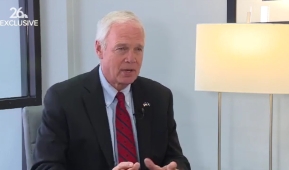
Vaclav Klaus, president of the Czech Republic, listens as he is introduced by Lee Bollinger, president of Columbia University, in New York, Monday March 9, 2009. ( AP photo)
Washington (CNSNews.com) - Czech Republic President Vaclav Klaus told CNSNews.com on Monday that his country has “accepted” last week’s move by U.S. President Barack Obama to annul missile defense plans in Eastern Europe.
 
“I have no special message, ” Klaus responded when CNSNews.com asked him to comment on the action taken by the Obama administration to abandon a missile defense strategy that was established by the Bush administration.
 
“We’ve accepted the solution done by the Obama administration,” he continued.
 
President Klaus spoke to CNSNews.com after delivering remarks at a conference about the collapse of communism in Central and Eastern Europe held by The Cato Institute, a Washington D.C.-based libertarian think-tank.  
 
The Czech president added that he was not surprised by the Obama administration overturning the Bush administration’s plans to place 10 missile interceptors in Poland and complementary radar stations in the Czech Republic.
 
“(L)istening to the debate in the last couple of weeks and months, it was for me quite clear that something might -- would -- happen,” Klaus told CNSNews.com. “It did happen, that’s all.”
 
Nevertheless, another Czech leader has criticized Obama for dropping the Bush’s administration missile defense plans.
 
Alexandr Vondra, deputy Czech prime minister for European affairs and a supporter of the Bush counter-missile attack strategy, made a statement in Berlin last week that Obama’s decision may come at the expense of U.S. military mission support in Central and Eastern Europe.
 
“It’s a U-turn in the U.S. policy,” Vondra said, as reported Sept. 18 in The New York Times.
 
“It must not undermine security guarantees in central and Eastern Europe,” he added. “Otherwise the United States may have a problem in generating support for out-of-area missions in this region.”
 
Regarding Vondra’s comment, Klaus told CNSNews.com: “I fully disagree with Mr. Vondra in this respect and in many others as well.”
 
In the U.S., John McCain (R-Ariz.), the ranking member of the Senate Armed Forces Committee, echoed Vondra’s concern, in a Sept. 17 statement, saying Obama’s decision would  jeopardize security and diplomatic commitments from the U.S. to the Czech Republic. 

“This decision calls into question the security and diplomatic commitments the United States has made to Poland and the Czech Republic, and has the potential to undermine perceived American leadership in Eastern Europe,” McCain stated. 

“Given the strong and enduring relationships we have forged with the region’s nations since the end of the Cold War, we should not, I believe, take steps backward in strengthening these ties. Yet I fear the administration’s decision will do just that, and at a time when Eastern European nations are increasingly wary of renewed Russian adventurism,” he added. 

Sen. Lindsey Graham (R-S.C.), another member of the Senate Armed Forces Committee, also criticized the abandonment of the missile-defense system, calling it a concession to the Russians, who deemed Bush’s plan a military threat. 

“This is going to be seen as a capitulation to the Russians, who had no real basis to object to what we were doing,” Graham said on NBC’s “Meet the Press” on Sunday.
 
He added: “At the end of the day you empowered the Russians, you made Iran happy and you made the people in Eastern Europe wonder who we are as Americans."

In an interview Sunday on CBS’ “Face the Nation,” Obama denied that his decision was influenced by Russia.

“My task here was not to negotiate with the Russians," the U.S. president said. "The Russians don't make determinations about what our defense posture is."

When asked why he pulled out from the anti-missile attack plans in Poland and the Czech Republic without getting anything in return from the Russians, Obama responded: "Russia had always been paranoid about this, but George Bush was right. This wasn't a threat to them. And this program will not be a threat to them.

"If the byproduct of it is that the Russians feel a little less paranoid and are now willing to work more effectively with us to deal with threats like ballistic missiles from Iran or nuclear development in Iran, you know, then that's a bonus" he added.

Russian President Dmitry Medvedev and Prime Minister Vladimir Putin have welcomed Obama’s decision to cancel the Bush era missile attack protection strategy.

“We appreciate the responsible approach of the U.S. president,” Medvedev said during televised remarks on Sept. 17, adding that Obama’s decision is in accordance with an agreement he made with Obama earlier this year. 

Putin called Obama’s decision “brave.”

In the Sept. 17 announcement, Obama said that he will replace Bush’s Eastern European missile plan with protections against short-and medium range missiles that the Iranians are developing.