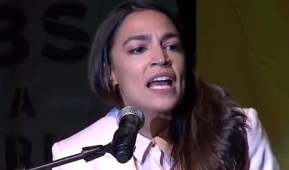
The panel discussion, sponsored by the liberal American Constitution Society for Law and Policy, was moderated by Los Angeles Times reporter David Savage. (Penny Starr/CNSNews.com)
(CNSNews.com) - A panel at the National Press Club on Tuesday described the Senate confirmation hearings for Supreme Court nominee Sonia Sotomayor as a “lost opportunity” to promote the benefits of ethnic and gender diversity on the bench.
 
“We’re here as a substitute for the Senate Judiciary Committee,” Los Angeles Times reporter and moderator David Savage said as he began the “Diversifying Our Courts” panel discussion, sponsored by the liberal American Constitution Society for Law and Policy.
 
“It was very clear from the opening round of statements that from the point of view of the Republican senators -- any discussion of her diverse background, they treated that as a sign that she couldn’t be an impartial justice, and that she would rule based on her personal prejudices and biases,” Savage said.
 
Republicans “wanted to be assured” that Sotomayor would not indulge her personal preferences and that she would follow the law, Savage added. “Of course she knew what the right answer was; she said, ‘I’m going to follow the law.’”
 
But others on the panel, including civil rights activists, said Sotomayor should bring her experiences as a Latino woman to bear on her court rulings.


Sherrilyn Ifill, a law professor at the University of Maryland, said on Tuesday that Supreme Court nominee Sonia Sotomayor should bring her experiences as a Latina to bear on her judicial decisions should she be confirmed. (Penny Starr/CNSNews.com)
Sherrilyn Ifill, law professor at the University of Maryland, said a justice brings more to the bench than knowledge. Their background contributes as well, Ifill said, giving them “something more to draw on than what they learned in law school, than what they derived from law books, than what they’ve learned in the courtroom.”
 
Ifill suggested that the “something more” is empathy: “They’re cuing to us that there is something about them that’s like something about us and that when they decide cases, that when you are in the conference, that when they are taking on this incredible important job, they bring to it experiences that mean that they can be proxies for us.
 
“They are in the conference room and we are in the conference room because they have come from the kind of experiences that most of us, at least many of us, have come from,” Ifill said.
 
Ifill criticized Republicans for bringing up a 2001 speech Sotomayor gave at the University of California, Berkeley, when she said a person’s ethnic background would play a role in how a judge rules in a court case.
 
“Whether born from experience or inherent physiological or cultural differences…our gender and national origins may and will make a difference in our judging,” Sotomayor said in that speech.
 
“Justice (Sandra Day) O'Connor has often been cited as saying that a wise old man and wise old woman will reach the same conclusion in deciding cases," Sotomayor continued, adding that she was "not so sure that I agree with the statement."  Sotomayor said first of all, she agreed with the statement that there is no universal definition of 'wise.' "Second, I would hope that a wise Latina woman with the richness of her experiences would more often than not reach a better conclusion than a white male who hasn't lived that life.”


Sylvia Lazos, also a panelist at the National Press Club on Tuesday and a law professor at the University of Nevada, Las Vegas, said diversity on the bench is an important part of the judicial process. (Penny Starr/CNSNews.com)
Panelist Sylvia Lazos, a law professor at the William S. Boyd School of Law at the University of Nevada, Las Vegas, said that a person’s background will and should affect their judicial decisions.

“We are convinced that you come up with better decisions when you have a diverse judiciary.” Lazos said. “I think it’s pretty much accepted these days, except for some Republicans on the Senate Judiciary, that people from different backgrounds will look at a set of facts in a very different kind of way.”

Lazos cited as an example the arrest for disorderly conduct of black Harvard Professor Henry Louis Gates Jr. by a white police officer in Cambridge, Mass., last month that sparked a national debate after President Barack Obama said the police had “acted stupidly” by arresting Gates.
 
“Who was right?” Lazos said. “We don’t know, but we know their backgrounds and their racial backgrounds have a lot to do with how they view so differently those set of facts.”
 
She said diversity plays an important role in how a judge reaches a decision.

“It’s this process of explaining why you’re coming up with this decision, not sounding condescending, not sounding like you are talking as a white male judge but talking as a judge that understands the reality of everybody,” she said, “I think is a very important part of the legitimacy function of the judiciary.”
 
Sotomayor is expected to be confirmed by the Senate Judiciary before the Senate adjourns for its summer break on Friday.