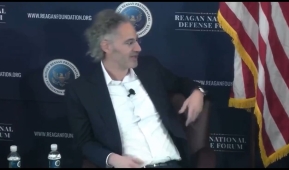
House Majority Leader Steny Hoyer (D.-Md.)
Washington (CNSNews.com) - House Majority Leader Steny Hoyer (D-Md.) took Monday’s fatal D.C. Metro accident as an opportunity to slap the Reagan administration for failure to adequately fund public transportation a quarter-century ago.

Yet the accident occurred despite the fact that Congress ignored Reagan and funded Metro anyway.

At a pen-and-pad briefing Tuesday, Hoyer was asked about the role of Congress in remedying the safety problems that have plagued Washington’s Metrorail system – and about a 2006 National Transportation Safety Board (NTSB) report outlining the inability of some subway cars to survive catastrophic crashes.

The top House Democrat told reporters he was aware of the report.

“I want to say that to the extent that that contributed to the injuries and the loss of life here, we need to look at that and that will be obviously impetus for making these cars safer,” Hoyer said. “As you know, it’s been 30 years, and as you know, the Reagan administration recommended no further money towards mass transit.”
 
Hoyer said that Reagan thought mass transit was a local obligation.
 
“Congress did not adopt that recommendation,” Hoyer said, adding that Congress chose to provide funds anyway.
 
“In fact, Metro has received probably more federal funds than any other metro system in the country,” he said.
 
Despite mentioning the 40th president’s stance on federal funding, Hoyer admitted he was not ready to conclude that a lack of resources might have contributed to the accident.
 
“We don’t know yet whether this was a human error, computer error, (or) equipment error,” he said, “all of which are, I suppose, possible.”
 
Hoyer called Washington’s Metro “America’s subway,” citing the millions of tourists who use it to visit the U.S. Capitol and “millions of rides per year by people who work for the federal government.”
 
“So it is appropriate for the federal government to make a very substantial investment,” he added.
 
But former NTSB managing director Peter Goetz told the Washington Post that Metro needs extensive upgrades that outpace the federal funding Hoyer cited.
 
“One report indicated that there were upwards of 7 billion dollars of upgrades needed for the D.C. system,” Goetz told the Post. “I don't know whether that number is correct but clearly more resources need to be directed to Metro.”
 
Monday’s accident killed 9 people and injured more than 70 others when one train ran into the back of another that was stopped on the tracks outside of the Fort Totten station in Northeast D.C.
 
The accident involved trains containing the oldest cars in the city’s aging fleet, termed the “1000 series,” which the NTSB deemed unsafe in 2006 but which went unfixed because of prohibitive cost.
 
When one train rolled back into another at the Woodley Park stop that year, the car that made direct impact telescoped into itself and overrode the first car of the stopped train. According to the accident investigation agency, the 1000-series train that rolled back was not crashworthy and caused “a catastrophic loss of nearly 34 feet of survival space in the passenger compartment.”
 
Metro refused to retrofit the cars per the NTSB’s safety recommendations because it would be “impractical” to do so before the scheduled phasing out of the old cars.
 
Monday’s accident, the most fatal in Metro’s history, also saw a 1000-series train override another.
 
President Obama’s nominee to head the NTSB, Patricia Hersman, told the Associated Press that Metro’s inability to fix the problem after the 2006 recommendations was “unacceptable.”
 
The newer 5000 series and planned 6000 series contain updated crash posts that better reinforce cars, but older series are still in use.