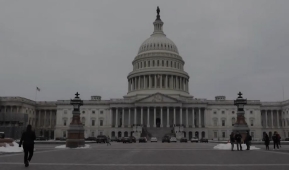
In this video image from APTN, the final vote tally is displayed after the Senate passed the Economic Stabilization Act by a vote of 74-25 Wednesday, Oct. 1, 2008, on Capitol Hill in Washington. (AP Photo/APTN)
(CNSNews.com) - The leading Republican on the Senate Banking Committee systematically shredded the $700-billion financial industry bailout bill in a speech delivered on the Senate floor last night shortly before the bill passed by a 75-24 vote.

Sen. Richard Shelby (R.-Ala.) concluded his indictment of the bill by telling Senate colleagues: “The choice we faced was between pursuing an informed response, or panic. I think we chose panic.”

The bill’s principal provision, like the bailout bill rejected in the House of Representatives on Monday, would provide up to $700 billion to the Treasury Department to buy mortgage-backed securities from financial institutions.

The bill would also authorize federal agencies that come into ownership of these securities to rework the underlying mortgages at risk of defaulting, decreasing the amount of principal and interest people owe on their houses.

Sen. John McCain (Ariz.), the Republican presidential candidate, and Sen. Barack Obama (Ill.), the Democratic presidential candidate, both returned to the Senate from the campaign trail to join with the Senate leadership of both parties in voting for the bill.

But Shelby, who has served in Congress since 1978, and who was chairman of the Banking Committee when the Republicans controlled the Senate, delivered a brief history of why he believes Congress itself caused the current financial crisis and why the action Congress took last night is unlikely to solve it.

He argued that the roots of the crisis can be found in well-intentioned attempts by members of Congress to conduct “social engineering” by deliberately loosening credit standards.

“The free market didn’t fail, the federal policies that created a false market did,” said Shelby.

He held up as major culprits behind the financial crisis the 1995 expansion the Community Reinvestment Act (CRA) under President Clinton and the loosening of mortgage standards under Fannie Mae and Freddie Mac, which were promoted by Democratic members of Congress.

The CRA, originally enacted under President Carter in 1977 and expanded under President Clinton in 1995, required banks to make more loans in inner cities and lower income communities.

“In 1995, I opposed the expansion of the Community Reinvestment Act, CRA, and the loosening of loan underwriting standards,” Shelby said. “My concerns were based on the simple fact that credit cannot be safely extended on any basis other than risk, and risk cannot be mitigated through social engineering.  The appropriate allocation of credit is not political, it is based on merit.  The CRA was an attempt to get around this inescapable fact, and it failed.

“I remind my colleagues tonight of this as we prepare to buy assets backed by the very same mortgages born of this flawed policy,” said Shelby. “The free market didn’t fail, the federal policies that created a false market did”

Shelby then turned his attention to the role of Fannie Mae and Freddie Mac in causing the crisis. These two organizations, taken over by the government last month, were known as Government Sponsored Enterprises (GSEs) because they were federally chartered, paid no state or federal income taxes, and had special lines of credit with the U.S. Treasury.

Fannie Mae and Freddie Mac purchased mortgages from banks and other lenders, bundled them together into securities and sold them to investment institutions.  The public policy purpose behind them was to make it easier for people to get home loans because the banks making the loans did not have to hold them but could turn around and sell them to the GSEs.

Fannie and Freddie reportedly had some involvement in almost half the mortgages in the United States.

“When I became chairman of the banking committee in 2003, I immediately became concerned with the financial health and the regulatory structure of the Government Sponsored Enterprises, Fannie Mae and Freddie Mac,” said Shelby. “I did not think that the entities had sufficient capital, management controls or regulatory oversight.

“I--and others on the committee with me--were troubled about their size because their combined portfolios then amounted to nearly $2 trillion,” said Shelby.  “In response to these concerns, we tried to pass tough GSE reforms.  Unfortunately, those efforts were rebuffed by the Democrats on the Banking Committee and on the floor of the Senate.

“Soon after the GSE’s went on a nearly trillion-dollar, subprime and Alternate-A mortgage-backed security spree.  Ladies and gentlemen, $1 trillion again,” said Shelby.  “Fannie and Freddie’s greatest allies were those who advocated and at times demanded that the GSEs continue to facilitate subprime and Alternate-A borrowing. As long as they complied, real regulation was dead.”

“This symbiotic relationship in turn fueled an already overheated market to grow even hotter,” said Shelby.  “As the driving force in mortgage finance, the GSEs purchasing effort also broke down when scant underwriting efforts remained in the marketplace.  Many, if not most, of the toxic assets that this taxpayer-funded bailout is designed to buy were originated in an atmosphere created by the GSEs and facilitated by their supporters right here in Congress.”

Shelby concluded with a scathing indictment of Congress itself.

“We did not get to where we are today by accident. It is a path that we chose,” he said.  “My warnings about the risk of basing credit decisions on well-intended social mandates rather than sound, fact-based underwriting were dismissed.”

He blamed his colleagues for rushing to another unexamined policy decision that could lead to further unintended consequences.

“To the extent other options exist, however, I believe we failed the American people by not examining them.  And we are doing something in haste,” he said.  “Many around here find comfort in the notion that something is better than nothing. I believe that is a false choice.  The choice we faced was between pursuing an informed response, or panic. I think we chose panic.”