An Israeli newspaper said U.S. Mideast envoy George Mitchell had asked a Netanyahu aide during a meeting in London Monday to block the planned construction and had been turned down, but State Department spokesman Ian Kelly declined to confirm this.
In White House reaction, press secretary Robert Gibbs Tuesday said the administration was “dismayed.”
“At a time when we are working to re-launch negotiations, these actions make it more difficult for our efforts to succeed,” he said. “Neither party should engage in efforts or take actions that could unilaterally pre-empt, or appear to pre-empt, negotiations.”
Gibbs said the U.S. position on Jerusalem was that it was one of the “permanent status” issues that must be resolved through Israeli-Palestinian negotiation (other “permanent status” issues identified in the Oslo peace accords include Jerusalem, the future of Palestinian refugees, and future borders.)
Palestinian Authority foreign minister Riyad al-Malki said the decision was yet another step “intended to prevent the Palestinian state from happening.”
The mayor of Jerusalem, Nir Barkat, issued a statement calling the U.S. stance discriminatory.
“Israeli law does not discriminate between Arabs and Jews, or between east and west of the city,” he said. “The demand to cease construction just for Jews is illegal, also in the U.S. and any other enlightened place in the world.
“It is inconceivable that the U.S. government would demand a construction freeze in the U.S. based on race, religion or sex, and the attempt to demand this from Jerusalem constitutes a double standard and is unacceptable,” Barkat said.
Suburb or settlement?
While rejecting attempts by the Obama administration to have him declare a complete freeze on settlement activity, Netanyahu has agreed not to build any new settlements in the disputed West Bank, not to expropriate any land to expand the boundaries of existing settlements, and to “adopt a policy of restraint on the existing settlements, but also one that would still enable normal life for the residents who are living there.”
But Netanyahu also has stressed that his government, like its predecessors, does not regard Israel’s capital as a “settlement.”
The issue came to the fore in July, when the State Department called in the Israeli ambassador to warn against a plan to allow the building of a small apartment building on a piece of privately-owned land elsewhere in Jerusalem.
Israeli media at the time reported that Netanyahu had expressed surprise at the U.S. stance, since he had made it clear to President Obama during their first meeting in Washington in May that “Jerusalem is not a settlement, and it has nothing to do with discussions on a freeze.”
The new row over housing permits comes at a time when P.A. chairman Mahmoud Abbas has been threatening not to run for re-election, unhappy that the U.S. government is not putting more pressure on Israel over settlements.
The P.A. leader in recent months has refused to return to peace negotiations, insisting as a precondition that Israel first announce a settlement freeze.
During a visit to Jerusalem at the end of October, Secretary of State Hillary Clinton angered Palestinian leaders by saying that Netanyahu’s agreement to curtail settlement construction – an agreement that fell short of Obama’s desire for a complete freeze – amounted to an “unprecedented” concession by Israel.
Clinton also agreed with Netanyahu that, ever since the launching of the Oslo process in 1993, an Israeli settlement freeze has never been a precondition for a resumption of talks.
Abbas is blaming Israel – and now the U.S. too – for the impasse; Netanyahu says he is ready to return to talks now, but without a newly-raised precondition.
“This is a new thing,” Netanyahu said during a joint press conference with Clinton, referring to Abbas’ settlement demand.
“Now, it’s true that you can take a new thing and you can repeat it
ad nauseum for a few weeks and a few months, and it becomes something that is obvious and has been there all the time,” he added. “[But] it’s not been there all the time.”
“What the prime minister is saying is historically accurate,” Clinton said moments later. “There has never been a precondition. It’s always been an issue within the negotiations.”
‘Move the embassy’
Israel annexed the eastern part of Jerusalem after capturing it during the 1967 Six Day War, before which it those areas were occupied by Jordan for 19 years.
Israel says its claim to Jerusalem is “eternal,” going back 3,000 years to the reign of King David from the city. The Palestinians want to establish the capital of a future independent state in Jerusalem, whose importance to Muslims is derived from the belief that Mohammed visited it during his “night journey” from Mecca to heaven.
The dispute over the city – and especially the Old City site where significant mosques are located at the place once occupied by the ancient Jewish Temples – is arguably the region’s thorniest issue.
Successive U.S. administrations have held the view that the future of Jerusalem should be a matter for Israelis and Palestinians to negotiate.
Like those of other countries, the American Embassy in Israel is located in Tel Aviv – a political decision reflecting the ongoing disagreement over control of Jerusalem.
The U.S. Congress in 1995 passed a law stating that “Jerusalem should be recognized as the capital of the State of Israel and the United States Embassy in Israel should be established in Jerusalem no later than May 31, 1999.”
But a waiver was built in and Presidents Clinton, Bush and
Obama all exercised it for consecutive six-monthly periods, citing national security interests.
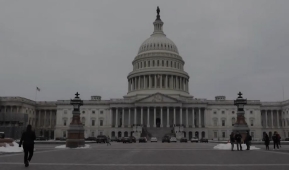
A group of senators is now supporting new legislation that would move the embassy to Israel’s capital but also remove the waiver.
“The United States maintains its embassy in the functioning capital of every country except in the case of our democratic friend and strategic ally, the State of Israel,” the text reads.
The measure, introduced by Sen. Sam Brownback (R-Ks.) and co-sponsored by five other Republicans and independent Sen. Joe Lieberman, was referred to the Foreign Relations Committee on Nov. 5.
Presidential candidates from both parties, including in recent years George W. Bush, Al Gore and Hillary Clinton, said while campaigning that they supported relocating the embassy to Jerusalem.